
Navigating the Frontiers of Human Intellect
Human knowledge evolves through observing, measuring, and interpreting the physical world. Scientific knowledge develops through systematic investigation, empirical evidence, and t...
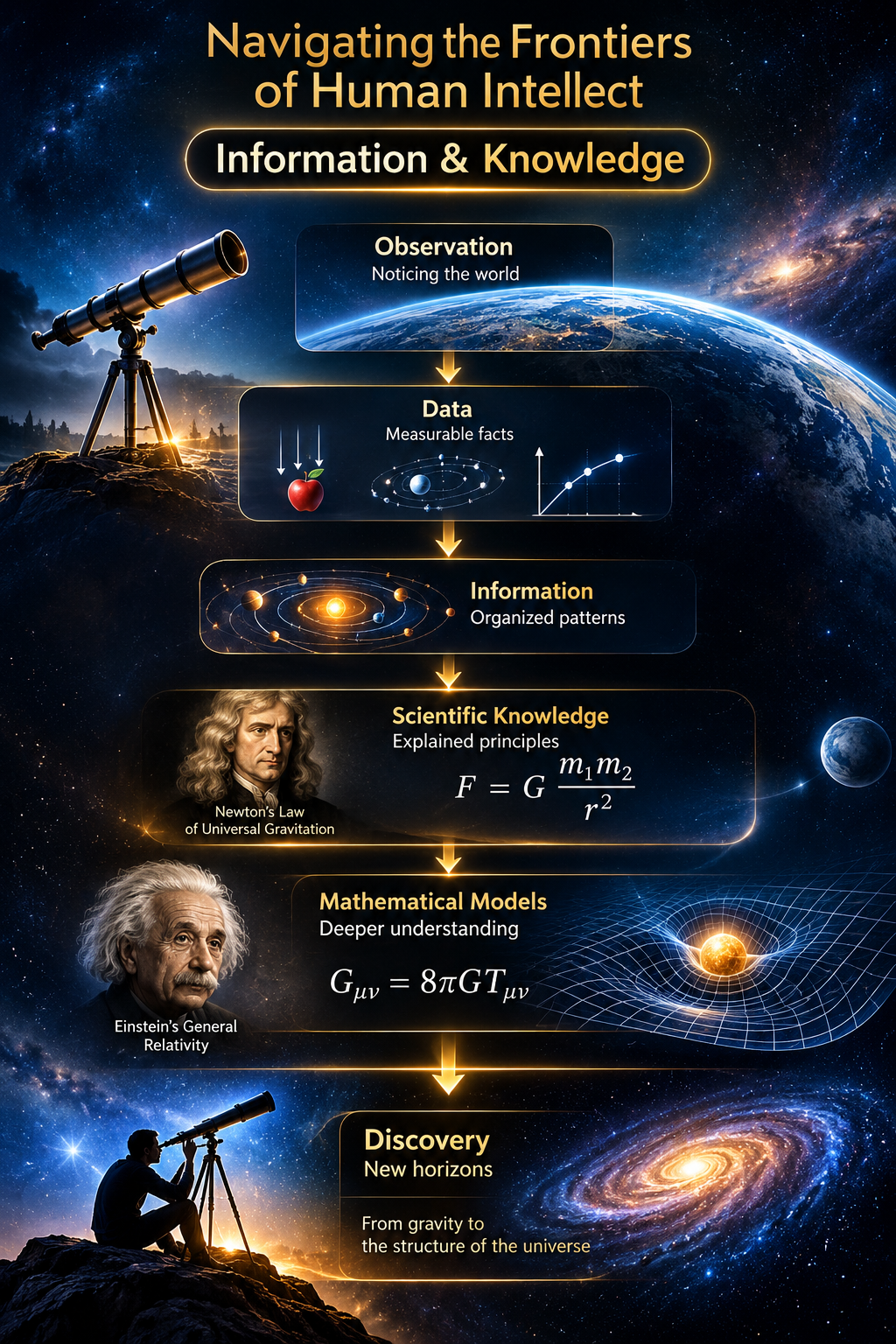
Human knowledge evolves through observing, measuring, and interpreting the physical world.
Scientific knowledge develops through systematic investigation, empirical evidence, and theories that explain natural phenomena. Understanding emerges through the systematic examination of natural phenomena, the collection of empirical evidence, the formulation of hypotheses, and the development of theories that explain observed patterns and relationships.
However, human intellect extends beyond direct observation. Our ability to reason mathematically, construct abstract models, and formulate hypotheses allows us to investigate phenomena that cannot be directly perceived or intuitively understood. This ability enables us to move beyond observable effects and explore the underlying mechanisms governing nature.
Consider gravity, for example. Humans have experienced gravitational effects throughout history, but understanding the mechanism and mathematical principles governing them required scientific investigation. In 1687, Sir Isaac Newton published his Principia Mathematica, establishing the law of universal gravitation. His formulation explained how every object with mass attracts every other object with mass and provided a mathematical framework for understanding planetary motion and falling objects. Centuries later, Albert Einstein's general theory of relativity fundamentally expanded this understanding by describing gravity as the curvature of spacetime caused by mass and energy.
This progression illustrates an essential characteristic of scientific knowledge: understanding is not a fixed collection of facts but an evolving framework built through observation, experimentation, mathematical reasoning, and continuous refinement. What we consider established knowledge today may be expanded, refined, or fundamentally reinterpreted as new evidence and deeper theoretical insights emerge.
Ultimately, navigating the frontiers of human intellect requires not only understanding what we already know but also recognizing the limitations of our current knowledge and developing the intellectual and scientific capabilities to investigate what remains unexplained.
Interactive Media & Embeds
Explore the embedded media, video streams, and social post references attached to this article.
Related Resource / Link
https://www.instagram.com/reels/Df27uC2Bw1D